

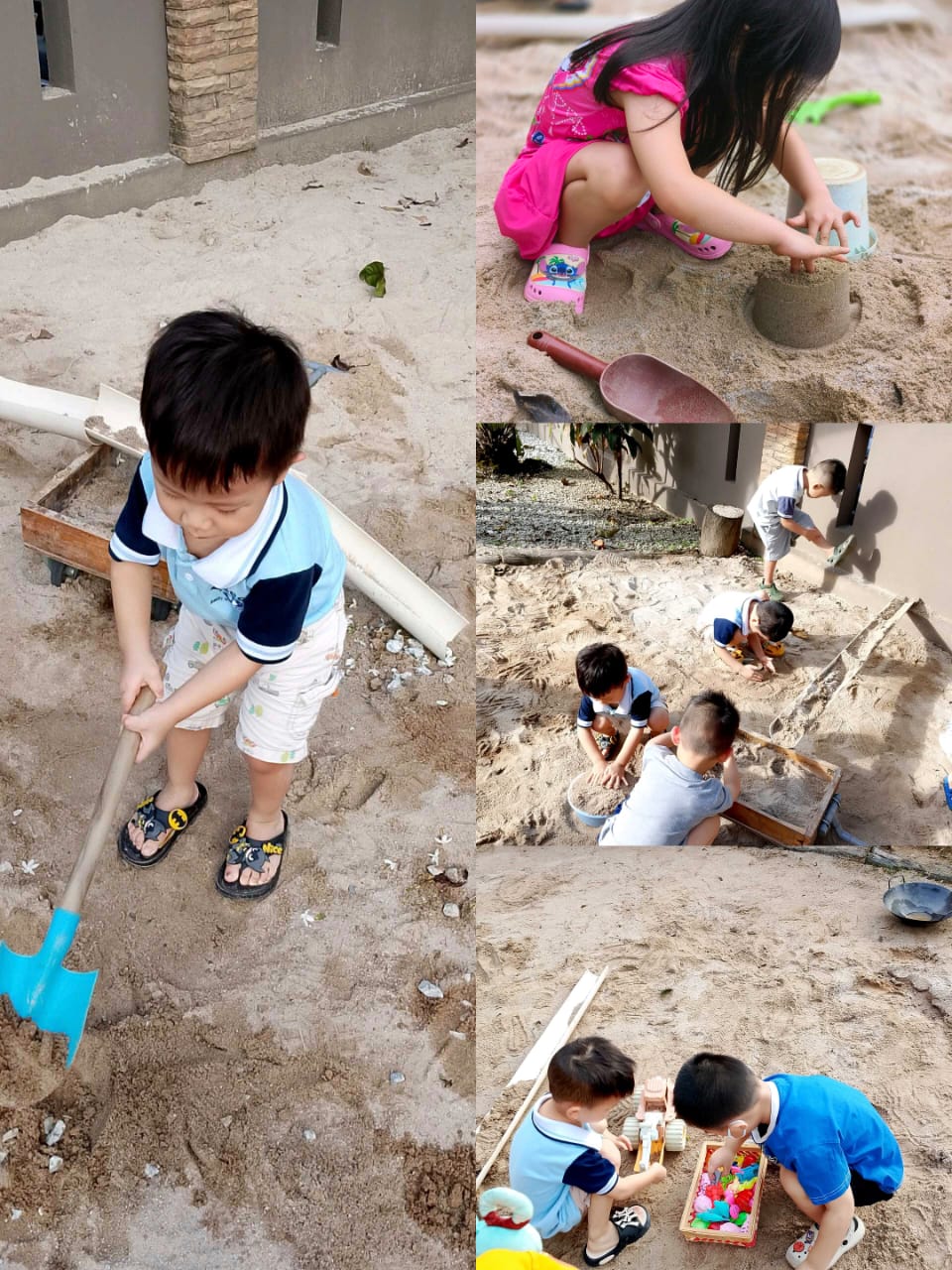
On this day, the learning space moved outdoors.
There were no tables or chairs—only sand, tools, containers, and open space.
Children began with their hands.
They dug, scooped, poured, and pressed, feeling the weight, texture, and resistance of the sand.
Some worked quietly on their own, fully focused on the movement of their bodies.
Others gathered naturally, sharing tools, watching one another, and building together.
A shovel became an extension of the arm.
A bucket turned into a mould.
Sand shifted from loose to firm, from formless to shaped—responding to the children’s actions.
There were no instructions on what to build.
Instead, children learned through trial and error:
What happens when the sand is too dry?
How hard should I press?
How can we make it stand?
Teachers observed nearby, allowing children the time and space to explore.
Rather than correcting, they listened—
supporting children to test ideas, solve problems, and negotiate with peers.
Through this simple yet rich experience, children were developing more than physical strength.
They were building coordination, persistence, collaboration, and confidence.
In a Reggio Emilia–inspired environment,
the outdoors is not just a place to play—
it is a classroom where thinking happens through the body.
这一天,学习空间延伸到了户外。
没有桌椅,也没有既定任务,
只有沙土、工具、容器,以及充满可能的空间。
孩子从双手开始探索。
他们挖、舀、倒、压,
感受沙子的重量、触感与变化。
有的孩子专注于自己的动作,
有的孩子自然地聚在一起,共用工具、互相观察、一起建造。
铲子成了手臂的延伸,
桶变成了模具。
沙土从松散到紧实、从无形到成形,
回应着孩子的每一个动作。
没有人告诉孩子要建什么。
他们在尝试中学习——
沙子太干会怎样?
要多用力才能成形?
怎样才能让它站得住?
老师在一旁观察与陪伴,
给予时间,而不是纠正;
倾听孩子的想法,
支持他们测试、解决问题,并与同伴协商。
在这个看似简单的活动中,
孩子发展的不只是身体力量,
还有协调能力、坚持力、合作能力与自信心。
在 Reggio Emilia 的学习环境中,
户外不只是玩耍的地方,
而是孩子透过身体思考与学习的课堂。